Rolling Shutter Video Installation Rolling Shutter Video Art 2017

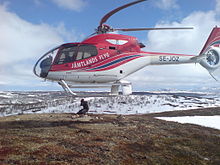
A Eurocopter EC-120 helicopter – the rotor blades seem to be swept back more than than usual due to the rolling-shutter effect.

Rolling shutter is a method of prototype capture in which a still picture (in a still photographic camera) or each frame of a video (in a video camera) is captured not by taking a snapshot of the entire scene at a unmarried instant in time but rather by scanning across the scene rapidly, vertically, horizontally or rotationally. In other words, non all parts of the image of the scene are recorded at exactly the same instant. (Though, during playback, the entire paradigm of the scene is displayed at once, as if information technology represents a single instant in time.) This produces anticipated distortions of fast-moving objects or rapid flashes of light. This is in contrast with "global shutter" in which the entire frame is captured at the same instant.
The rolling shutter can be either mechanical or electronic.[1] [two] The advantage of this electronic rolling shutter is that the image sensor can proceed to gather photons during the acquisition process, thus effectively increasing sensitivity. It is found on many digital still and video cameras using CMOS sensors. The effect is nigh noticeable when imaging extreme conditions of motion or the fast flashing of light. While some CMOS sensors use a global shutter,[3] the majority found in the consumer market place use a rolling shutter.
CCDs (charge-coupled devices) are alternatives to CMOS sensors, which are mostly more sensitive and more expensive.[ citation needed ] CCD-based cameras ofttimes use global shutters, which take a snapshot representing a "relative" unmarried instant in time and therefore do non endure from the motion artifacts acquired past rolling shutters.[four]
Baloney effects [edit]
Rolling shutters can crusade such effects equally:[v]
- Wobble. This miracle (also known as the jello event) appears when the camera is vibrating, in situations such as hand-held shots at telephoto settings, or when shooting from a moving vehicle. The rolling shutter causes the image to wobble unnaturally.
- Skew. The image bends diagonally in one direction or another as the camera or subject moves from one side to another, exposing dissimilar parts of the paradigm at unlike times. Skew is a pocket-sized manifestation of the wobble phenomenon described above.
- Spatial aliasing. Vertically side by side pixels are sampled in violation of the sampling theorem, when the camera or object motion is likewise rapid. One example of this is imaging of a chop-chop rotating propeller. The smear of each bract is caused by the propeller rotating at the same or nigh the same speed that the frame is read by the camera. Viewed perpendicular to a fan spinning clockwise, the blades on the left side appear thinner than usual while the blades on the correct side appear thicker, and can even appear as if they aren't continued at the center.
- Temporal aliasing, including fractional exposure. If a photographic camera flash goes on for merely office of the fourth dimension of the exposure, the illumination of the flash may simply exist present for some rows of pixels in a given frame. For example, the elevation 1/iii of the picture may be brightly lit by a flash, while the bottom ii/3 of the picture show is dark and unlit, equally the flash was off by the fourth dimension that part of the CMOS was sequenced. The departure betwixt the 2 distinct parts of the frame tin look odd. Similar problems can arise with fluorescent lighting, strobe effects, lightning, or whatever extreme state of affairs where very fast move or very fast bursts of calorie-free are seen in the time between when the CMOS chip sequentially records a frame.
The effects of a rolling shutter tin prove hard for visual effects filming. The process of matchmoving establishes perspective in a scene based on a single point in time, simply this is difficult with a rolling shutter that provides multiple points in time inside the same frame. Final results depend on the readout speed of the sensor and the nature of the scene beingness filmed; as a rule of thumb, higher-stop cinema cameras will accept faster readout speeds and therefore milder rolling shutter artifacts than low-end cameras.
Images and video that suffer from rolling shutter baloney can exist improved by algorithms that do rolling shutter rectification, or rolling shutter compensation. How to do this is an active area of research.[5]
-

A photo exhibiting fractional exposure. Lighting conditions changed betwixt the exposure of the meridian and lesser parts of the photo.
-

Skewing in a photograph taken from a motorcar moving at 80 km/h (50 mph). Objects in the foreground, such as the debate and gate, have become skewed, while more distant objects in the background, such as the cliff, remain every bit normal.
Encounter also [edit]
- Digital artifact
- Strip photography
- Wagon-bicycle effect
Notes [edit]
- ^ "Electronic shuttering: Rolling vs Global shutter" (PDF). Motionvideoproducts. Retrieved 2011-12-22 .
- ^ Shutter Operations for CCD and CMOS Image Sensors Kodak
- ^ "TrueSNAP Shutter Freezes Fast-Moving Objects" (PDF). Eric Fossum. 2013-11-xiii. Retrieved 2013-xi-xiii .
- ^ "To CCD or to CMOS, That is the Question | B&H Photo Video Pro Audio". Bhphotovideo.com. Retrieved 2010-08-21 .
- ^ a b
{{cite web}}: CS1 maint: multiple names: authors listing (link)
External links [edit]
- Rolling Shutter Tutorial from the CVPR 2012 briefing.
- Airplane propeller blades - rolling shutter result on YouTube
- Bass strings - rolling shutter upshot (vimeo)
- 3D rendering explaining how a rolling shutter produces the foreign propeller airplane outcome on YouTube
- Splendid explanation/simulation of rolling shutter effect from Smarter Every Day on YouTube
- Solutions for rolling shutter
Source: https://en.wikipedia.org/wiki/Rolling_shutter
0 Response to "Rolling Shutter Video Installation Rolling Shutter Video Art 2017"
Post a Comment